




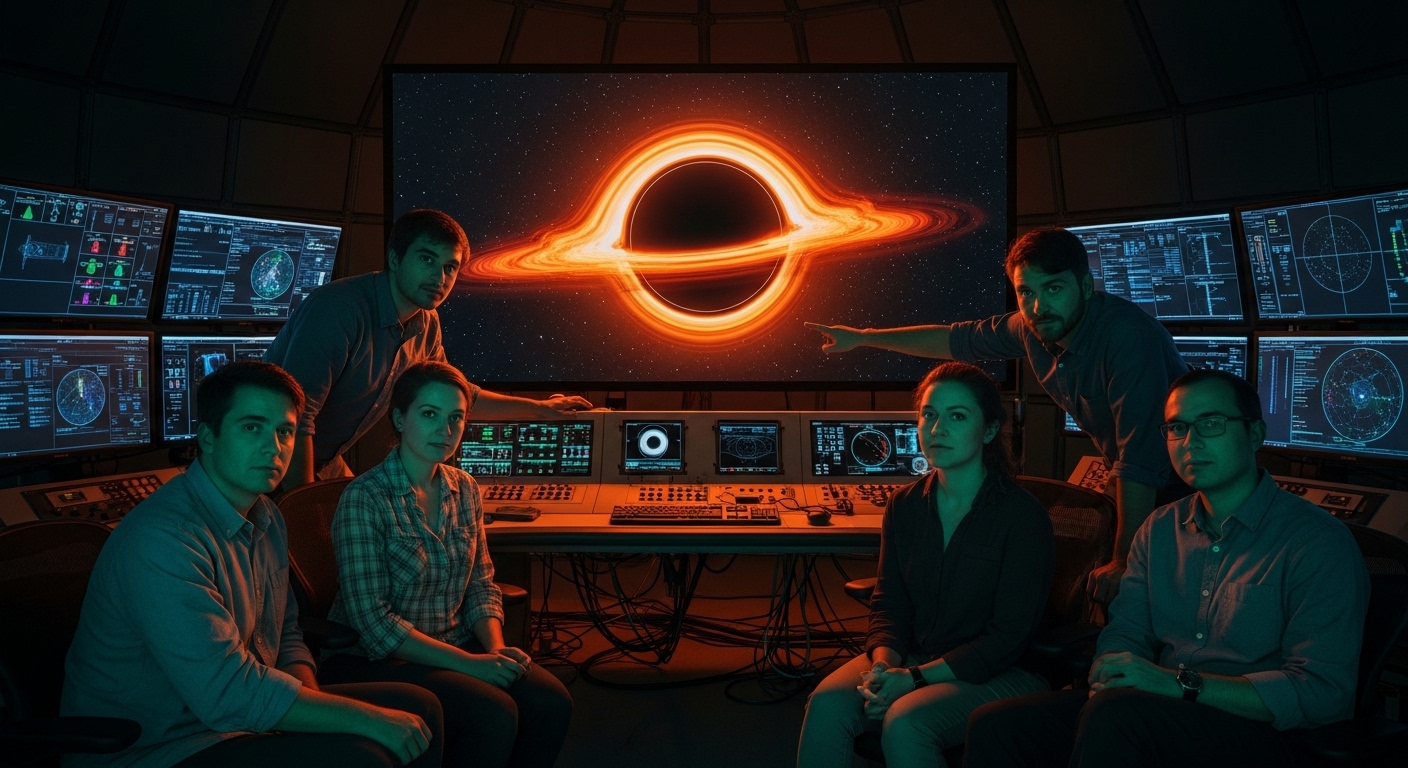
First ever black hole image released
In one of the most significant scientific achievements of the modern era, astronomers working with the Event Horizon Telescope have released the first ever direct image of a black hole — a feat that, until recently, many believed to be physically impossible. The image, released on April 10, 2019, at simultaneous press conferences held across the globe, shows a ring of superheated orange-red gas surrounding a dark central void: the shadow of the supermassive black hole at the centre of Messier 87, a galaxy located some 55 million light-years from Earth.
The black hole itself — designated M87* — has a mass 6.5 billion times that of our Sun. To image it, the Event Horizon Telescope collaboration linked a worldwide network of eight ground-based radio telescopes into a single, Earth-sized observing array, using a technique called very-long-baseline interferometry. The telescopes stretched from Hawaii and Mexico to Spain, Chile, and Antarctica, and were synchronised using atomic clocks precise to within a fraction of a nanosecond. The resulting instrument had the resolving power needed to read a newspaper in New York from a pavement café in Paris.
The image is more than a stunning photograph — it is a profound scientific validation. The dark shadow at the centre matches the predictions of Albert Einstein’s general theory of relativity with extraordinary precision. Scientists had long been confident that black holes existed, based on the behaviour of stars and gas near galactic centres, but seeing one directly — seeing the point beyond which nothing, not even light, can escape — is something else entirely. ‘We are giving humanity its first view of a black hole — a one-way door out of our Universe,’ said EHT project director Sheperd Doeleman.
The image also captured the imagination of the wider public in a way that few scientific breakthroughs manage to do. It appeared on the front pages of newspapers in dozens of countries and became one of the most downloaded images in the history of the National Science Foundation. Science magazine later named it the Breakthrough of the Year. Among the 200-plus scientists who contributed to the result was Katie Bouman, a young computer scientist who developed one of the key imaging algorithms — her story went viral, sparking a broader public conversation about the role of women in science. The black hole, once purely an abstraction, now has a face.